Round 3 of 22 • Formula 1 Aramco Japanese Grand Prix • Suzuka Circuit • 29 March 2026
Antonelli Claims Championship Lead at Suzuka: A Historic Weekend That Rewrote Formula 1's Record Books
31 March 2026
Race Result — Top Three
| Pos | Driver | Team | Time / Gap |
|---|---|---|---|
| P1 | Kimi Antonelli | Mercedes | 1:28:03.403 |
| P2 | Oscar Piastri | McLaren | +13.722s |
| P3 | Charles Leclerc | Ferrari | +15.270s |
| P4 | George Russell | Mercedes | +15.754s |
| P5 | Lando Norris | McLaren | — |
| P6 | Lewis Hamilton | Ferrari | — |
| P7 | Pierre Gasly | Alpine | — |
| P8 | Max Verstappen | Red Bull | — |
| P9 | Liam Lawson | Racing Bulls | — |
| P10 | Esteban Ocon | Haas | — |
Nineteen years old. Nine points clear at the summit of the world championship. Two victories from three starts. The question forming across the paddock at Suzuka was one nobody anticipated asking this early in the season: is this already the Kimi Antonelli era? The rest of the grid might want to hope he never figures out his getaways.
The statistic that anchors this weekend above all others: Antonelli is now the youngest driver to lead the Formula 1 World Championship in the sport’s 76-year history. Lewis Hamilton set the previous benchmark at the 2007 Spanish Grand Prix, aged 22 years and five months. A nineteen-year-old from Bologna has just moved that marker back by nearly three years. Records of that magnitude are not supposed to fall this way — quietly, in the middle of a chaotic afternoon at Suzuka, without ceremony. Antonelli did not seem to notice. He was already thinking about Miami.
There is, however, more to the story than one driver’s brilliance. Sunday at Suzuka brought a frightening accident, a Safety Car that rewrote the afternoon, a teammate venting his frustration over team radio, and pace data that raises serious questions about the competitive order for the rest of the season. The headline belonged to Antonelli. The detail belongs to everyone else.
Race Highlights — How the Japanese Grand Prix Unfolded
Suzuka rarely disappoints, and the 2026 running was no exception. A squandered pole position, a midfield collision that triggered a race-defining Safety Car, and a teenager rewriting history in the space of fifty-three laps. This is how the afternoon unfolded.
Lap 1: Antonelli, on pole, produces a catastrophic getaway and drops to sixth. Piastri does the opposite, storming to the lead as both Mercedes cars flounder in the opening corners. The Suzuka crowd gets exactly the race they wanted.
Lap 4: Russell, recovering magnificently, picks off Leclerc and Norris in quick succession to run third. Antonelli is up to fifth, hunting his own teammate like a heat-seeking missile through the Esses.
Lap 15: Piastri boxes first. Russell inherits the lead and immediately begins pulling away. For five laps, this looks very much like Russell's afternoon.
Lap 21: Russell pits. Antonelli, yet to stop, assumes the provisional lead. The plan is to nurse it until the lap count forces him in — but fate, as it often does at Suzuka, has other ideas entirely.
Lap 22: Ollie Bearman attempts an ambitious pass on Franco Colapinto at Spoon Curve. The Haas snaps sideways onto the grass, collects multiple barriers and impacts the wall at a reported 50G. Bearman is assisted away by marshals before slumping to the ground; thankfully, X-rays confirm only a right knee contusion. The Safety Car is deployed and changes the complexion of the entire race.
Lap 22 (continued): Antonelli dives into the pits under the Safety Car for a free stop. He rejoins in P1 with fresh rubber. Russell, who had pitted a lap earlier, is immediately on the radio: “Unbelievable. Wow. Our luck in these last two races.”
Lap 27 onwards: The Safety Car peels off. Antonelli controls the restart with composed authority, building a gap in the opening laps of the second stint. Behind him, Russell spends the closing stages locked in a three-way battle with Leclerc and Hamilton — believing he has sealed P3, only for Leclerc to swoop back around the outside on the main straight with three laps remaining.
Lap 53: Chequered flag. Antonelli wins by 13.7 seconds over Piastri. He is, officially, the youngest driver in history to lead the Formula 1 World Drivers’ Championship. The Silver Arrows celebrate. Russell reflects on another afternoon of misfortune.
“It feels pretty good. Of course it is still early days to think about the championship, but we are on a good way. I had a terrible start — I just need to check what happened — but then I was lucky with the Safety Car to be in the lead. Then the pace was just incredible and it was a really nice second stint. I felt very good with the car and very pleased with that.”
— Kimi Antonelli, post-race, Suzuka 2026
The Historic Record in Numbers
To properly contextualise what Antonelli has achieved in the opening three rounds of 2026, consider the following:
- 19 years and 216 days — Antonelli’s age when he assumed the championship lead, beating Hamilton’s record by nearly three years.
- First Italian to lead the Drivers’ Championship since Giancarlo Fisichella after the 2005 Australian Grand Prix.
- First teenager to lead the world championship in the sport’s history.
- 2 wins from 3 races — China and Japan — with a combined winning margin of over 19 seconds.
- 72 points in three races (and one sprint).
Championship Standings After Round 3 — Japan
Drivers’ Championship
| Pos | Driver | Team | Points |
|---|---|---|---|
| 1 | Kimi Antonelli | Mercedes | 72 |
| 2 | George Russell | Mercedes | 63 |
| 3 | Charles Leclerc | Ferrari | 49 |
| 4 | Lewis Hamilton | Ferrari | 41 |
| 5 | Lando Norris | McLaren | 25 |
| 6 | Oscar Piastri | McLaren | 21 |
| 7 | Oliver Bearman | Haas | 17 |
| 8 | Pierre Gasly | Alpine | 15 |
| 9 | Max Verstappen | Red Bull | 12 |
| 10 | Liam Lawson | Racing Bulls | 10 |
Constructors’ Championship
| Pos | Constructor | Points |
|---|---|---|
| 1 | Mercedes | 135 |
| 2 | Ferrari | 90 |
| 3 | McLaren | 56 |
| 4 | Red Bull | 16 |
Race Pace Analysis — What the Numbers Actually Show
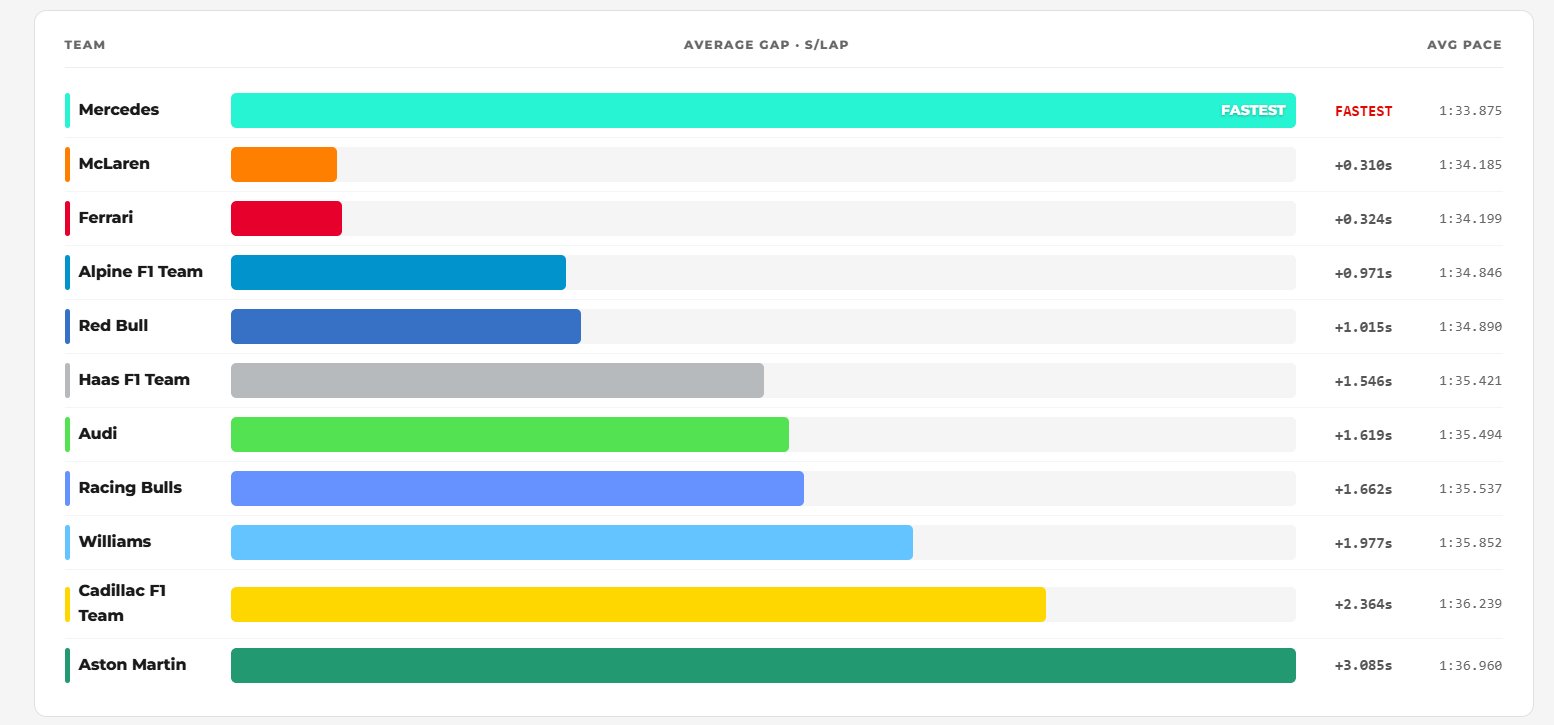
The final classification told one story. The average lap pace data told a more revealing one. Strip away the Safety Car, the botched starts, and the strategic fortune, and what you are left with is a picture of where each team genuinely stands on pure performance — and the gaps are both illuminating and, in some cases, deeply uncomfortable reading.
Mercedes — A Class of Their Own
The W17 averaged 1:33.875 per lap around Suzuka — the fastest of any team on the grid by a margin that demands attention. That is not a marginal advantage won through tyre management or tactical nous. It is a fundamental gap in outright pace, and it explains why, even after Antonelli dropped to sixth on the opening lap, a Mercedes victory never felt entirely out of reach. When the machinery underneath you is 0.3 seconds per lap quicker than your nearest rivals, the sport has a way of correcting itself — Safety Car or otherwise.
McLaren and Ferrari — Separated by Centimetres
The most intriguing story in the pace data is the near-identical performance of McLaren and Ferrari in race trim. McLaren averaged 1:34.185 per lap, Ferrari 1:34.199 — a difference of just fourteen thousandths of a second per lap across a 53-lap race. Both teams are sitting approximately 0.31 to 0.32 seconds per lap behind Mercedes, which translates to a gap of roughly 16 to 17 seconds over a full race distance under equal conditions. That is the deficit they must close. The constructors’ battle between these two for second place in the championship promises to be exceptionally tight, and the development race through April and into Miami may well determine which of them has the stronger hand for the European summer.
Alpine — The Midfield Pacesetter
Alpine deserve particular credit for what the pace chart reveals. At +0.971 seconds per lap to Mercedes, the French outfit are comfortably the quickest team outside the top three constructors, and they hold a meaningful 0.044-second advantage over Red Bull. Pierre Gasly’s P7 finish was not a fluke born of strategy or attrition — it was backed by genuine pace. If Alpine can maintain this kind of performance consistency through the season, they will be a genuine threat to accumulate significant points in the midfield championship battle.
Red Bull — The Magnitude of the Problem
For a team that won the constructors’ championship as recently as 2023, the pace data from Suzuka makes for grim reading. Red Bull averaged 1:34.890 per lap — +1.015 seconds behind Mercedes, and crucially, +0.705 seconds behind Ferrari. That is not a development gap that a single aerodynamic upgrade package closes over a five-week break. The Red Bull-Ford power unit is simply not delivering the electrical output of its rivals under race conditions, and until that changes, Verstappen will continue to find himself racing a car that is structurally incapable of challenging for victories at this level of competition. The gap to Alpine alone — a team operating on a fraction of Red Bull’s budget and resources — should be the most alarming number in the Milton Keynes debrief room on Monday morning.
The Back of the Grid — Wide Gaps and Difficult Realities
Further down the order, the pace data exposes just how wide the spread has become under the 2026 regulations. Haas averaged +1.546 seconds per lap to Mercedes, Audi +1.619 seconds, and Racing Bulls +1.662 seconds — a cluster of three teams separated by barely a tenth of a second per lap but collectively sitting well over a second and a half from the front. For Haas, who hold P7 in the drivers’ standings thanks largely to Bearman’s points haul before his Suzuka retirement, the underlying pace data is a reminder that their championship position may flatter their actual competitiveness.
Williams and Cadillac sit deeper still, at +1.977 and +2.364 seconds per lap respectively, while Aston Martin’s average of +3.085 seconds per lap — the slowest of any team on the grid — underlines the scale of the challenge facing Fernando Alonso and Lance Stroll. Three seconds per lap to the benchmark is an enormous deficit, and Alonso’s increasingly pointed public comments about the nature of the 2026 regulations begin to make more sense when viewed through the prism of that number. This is not a car capable of scoring points at present circuits. Aston Martin need a substantial step forward, and they need it before the European rounds arrive.
Behind the Garage Doors — Paddock Analysis
The safety conversation is the most urgent in the paddock right now, and it cannot be deferred until Miami. McLaren Team Principal Andrea Stella raised the issue of excessive closing speeds during pre-season testing. Norris echoed the concern in Australia. Bearman’s 50G accident at Spoon Curve on Sunday was, by the assessment of multiple respected analysts, a foreseeable consequence of the way the 2026 active aerodynamics and battery management systems interact at high speed. A driver coming off the override zone and recovering aero downforce encounters a closing speed differential that has no equivalent in any previous era of the sport. Reports from within the FIA suggest a review of qualifying aero allocations is already under consideration. It should be accelerated.
Elsewhere, the Red Bull situation is one of the more compelling subplots of the season. Max Verstappen in ninth after three rounds is not a sporting result that reflects his ability — it reflects the reality that the Red Bull-Ford power unit is not yet delivering competitive hybrid performance against Mercedes, Ferrari, or even Audi’s programme. Verstappen’s comments in the post-race media session were pointed without being explosive, but the direction of travel is clear. Significant aerodynamic updates are expected in Miami. How Red Bull responds over the five-week break will say a great deal about the team’s capacity to mount a second-half challenge.
Ferrari, for their part, are the story of quiet consistency. Hamilton in P4, Leclerc in P3 — the SF-26 is a clean, reliable machine that lacks the outright pace of the W17 but rarely puts a foot wrong. The constructors’ gap of 45 points is not insurmountable over a 22-race season, but Ferrari will need a meaningful upgrade package before the European rounds if they are to sustain their challenge.
Analysis — What Suzuka Tells Us About the 2026 Season
It bears saying plainly: Kimi Antonelli is not a flash in the pan. Two wins in three races, one of them recovered from sixth place on the opening lap, tells you something about composure that most drivers spend years acquiring. He is not yet a complete package — the start issues in Japan are a genuine technical and procedural problem that must be resolved before Miami — and he was refreshingly candid about the role the Safety Car played in his victory. That self-awareness at nineteen years of age is itself a form of maturity the sport does not always see in its young talents.
George Russell’s situation deserves more measured treatment than it typically receives. The man has driven with genuine pace in two of three races this season and been punished by circumstances on both occasions. The radio frustration is understandable; less helpful is what it may signal about the psychological dimension of the intra-team battle. Hamilton spent fifteen years learning to insulate his mental state from those moments. Russell is at Mercedes on a mandate to be champion, and his nineteen-year-old teammate — on paper, the junior partner in the arrangement — is currently delivering the more dominant performances. The gap is nine points. In the context of a twenty-two-race season, that is nothing. But Russell needs a weekend in Miami where the car, the strategy, and the Safety Car timing all fall his way.
And then there is Verstappen. Four consecutive championships. The most dominant driver of his generation. Ninth after three rounds, in a car that is simply not competitive enough to challenge at the front. He is not worse than before. The machinery underneath him is. And if Red Bull cannot find at least one second of pace before the summer, it will be the first season (since 2020) in which Verstappen is genuinely irrelevant to the title outcome.
Looking Ahead — Miami Grand Prix, 1–3 May 2026
Formula 1 now enters a five-week break before the sport reconvenes at Hard Rock Stadium in Miami for Round 4. It is a Sprint weekend, which means additional points are available across Saturday’s shorter format race — crucial for Verstappen and McLaren if they are to close ground on the leading pair.
Miami’s circuit profile — tight, technical, with premium on clean laps and strong traction — will test the 2026 active aero systems very differently to Suzuka. Teams will spend April in intensive development work; McLaren have confirmed both the MTC and their composites facility will be operating at full capacity through the break. Red Bull will reportedly bring a revised aerodynamic package. Mercedes will be working to solve the start procedure issues that have compromised Antonelli and Russell on consecutive weekends.
Prediction: McLaren will take at least one Sprint podium in Miami. The momentum from Piastri’s return-to-form P2 in Japan is significant, and the Sprint format rewards the kind of aggressive, single-lap pace that car has shown in shorter bursts. Expect Verstappen to be a factor in Florida — motivated, on a circuit that historically suits his instincts, with a revised car beneath him. And expect Antonelli to continue carrying the championship lead through the break. Two wins from three races. The youngest leader in the sport’s history. Miami awaits.
Readers — Have Your Say
Who wins the 2026 Drivers’ World Championship?
Will Kimi carry on with this level of consistency across a full twenty-two-race season, or will George Russell — with his experience, composure under pressure, and a point to prove — ultimately reign supreme in the intra-team battle that could decide the whole championship? And perhaps the bigger question for the paddock heading into Miami: is there any team out there with the pace, the development rate, and the raw ambition to genuinely close down a Mercedes outfit that currently leads both championships by a substantial margin? Ferrari are the closest on paper, McLaren are gathering momentum, and Red Bull will not stay quiet for long. The five-week break may tell us more than the three races that preceded it.
Share this article with a fellow supporter ahead of the five-week break. The arguments, at least, need not wait until May.
All results sourced from the official Formula 1 website and the FIA. Championship standings correct as of 29 March 2026.